Disclosure: This post contains affiliate links. As an Amazon Associate, we earn from qualifying purchases.
Decking joists are the horizontal framing members that support your deck boards, transferring loads from people, furniture, and wind to the beams and posts. They keep your deck aligned, evenly spaced, and stable, influencing safety and performance. Common sizes are 2×6, 2×8, or 2×10, spaced 12 or 16 inches on center, and must suit span, load, and material grade. Install with corrosion-resistant connectors, follow code spacing, and plan for long-term durability—you’ll uncover more details ahead.
What Deck Joists Are and Why They Matter for Strength and Safety
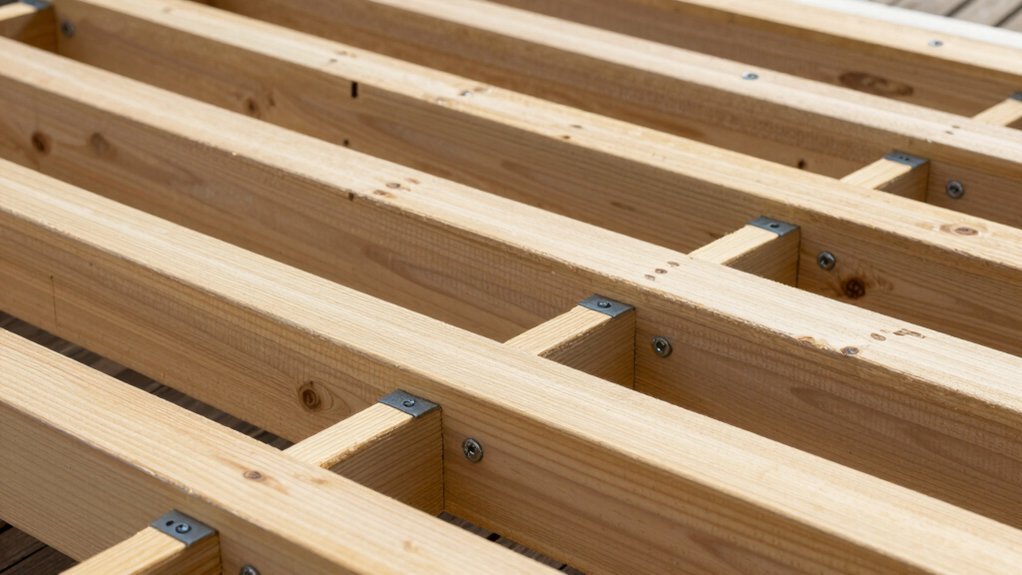
Deck joists are the horizontal members that support your deck boards, transferring loads from people, furniture, and wind into the ledger, beam, and foundations. You rely on joists to maintain alignment, spacing, and load distribution, which directly affects overall safety and performance.
Joist strength depends on species, grade, and cross-sectional dimensions, as well as fastener quality and installation methods. Properly sized joists resist bending, shear, and deflection under anticipated live and dead loads, maintaining level surfaces and reducing trip hazards.
Material durability matters because exposure to moisture, fungi, and decay governs long-term performance. Selecting treated or naturally durable wood or engineered alternatives mitigates deterioration.
In practice, verify manufacturer specifications, local codes, and corrosion protection to ensure reliable support and structural safety.
Typical Deck Joist Sizes and Spacing Standards
You’ll start with typical deck joist sizes and explain how they affect load capacity and overall framing.
Next, I’ll outline spacing standards for common joist grades and deck widths, highlighting typical gaps and the impact on deflection.
Finally, I’ll share practical tips on spans, supports, and how to verify you meet code requirements for safety and durability.
Typical Deck Joist Sizes
Typical deck joists vary by span, load, and wood species, but common residential layouts use nominal sizes such as 2×6, 2×8, or 2×10.
Spacing is typically 12 inches on center for longer spans and 16 inches on center for standard applications.
In practice, you select joist size based on deflection limits, grade, and anticipated loads, ensuring the member supports both live and dead loads with appropriate bending capacity.
Consider lumber species and moisture conditioning, as these affect stiffness and long-term performance.
Precise joist installation hinges on correct end bearing, rim board compatibility, and secure fastening patterns to resist uplift and lateral movement.
Verify bridging or blocking at intermediate supports to maintain a uniform deck surface, reduce bounce, and optimize decking durability.
Spacing Standards Overview
Spacing standards for deck joists balance load capacity with practical installation. You’ll use established spacing guidelines to ensure safety while simplifying construction. Typical joist spacing ranges from 12 to 16 inches on center for most residential decks, with tighter spacing under heavy loads or thicker decking.
For longer spans, you may increase joist size rather than reduce spacing, preserving structural integrity. Material choice, species, and grade affect allowable spans; always reference local code and manufacturer tables.
Consider environmental conditions, as moisture and temperature can alter stiffness and response, impacting longevity. Decking aesthetics matter: uniform spacing enhances visual rhythm and prevents uneven board gaps.
Environmental impact factors include choosing sustainably sourced lumber or alternative materials, and ensuring proper drainage to minimize rot risk. Precision in layout reduces waste and strengthens overall performance.
Support and Span Tips
When selecting deck joist sizes and spacing, prioritize load requirements, span, and material characteristics.
In this section, you assess standard spans and common lumber grades to determine suitable joist dimensions. For typical residential decks, 2×6 or 2×8 joists are common, spaced 12 to 16 inches on center, depending on the load and decking thickness.
Larger spans may require 2×10 or 2×12 members, with steel connectors or blocking to maintain stiffness. Consider joist insulation to reduce thermal bridging and improve comfort near outdoor living spaces.
If you’re using decorative joists, ensure they meet structural criteria and don’t compromise load paths.
Verify code-prescribed spacing, fastening patterns, and rim/beam support to prevent deflection and ensure uniform deck performance.
Deck Joist Materials: Pros, Cons, and Fit for Your Climate
Choosing deck joist materials depends on climate, load demands, and maintenance willingness; each option—pressure-treated lumber, high-performance engineered wood, and alternative substrates—offers distinct strengths and drawbacks.
You assess material durability to predict longevity under weather exposure, decay risk, and fastener compatibility.
Pressure-treated lumber provides cost efficiency and proven stiffness but may warp with moisture cycles and require preservative sealing.
High-performance engineered wood delivers improved strength-to-weight ratio, dimensional stability, and reduced shrinkage, yet can incur higher upfront costs and moisture tolerance limits.
Alternative substrates, such as composite blanks or metal, offer superior fade resistance and longevity in harsh climates but demand specialized fasteners and precise installation to prevent thermal expansion issues.
Climate compatibility guides selection, ensuring sustained performance, fewer maintenance cycles, and predictable load bearing over time.
Interpreting Joist Sizing: Reading Span Tables and Sizing Charts
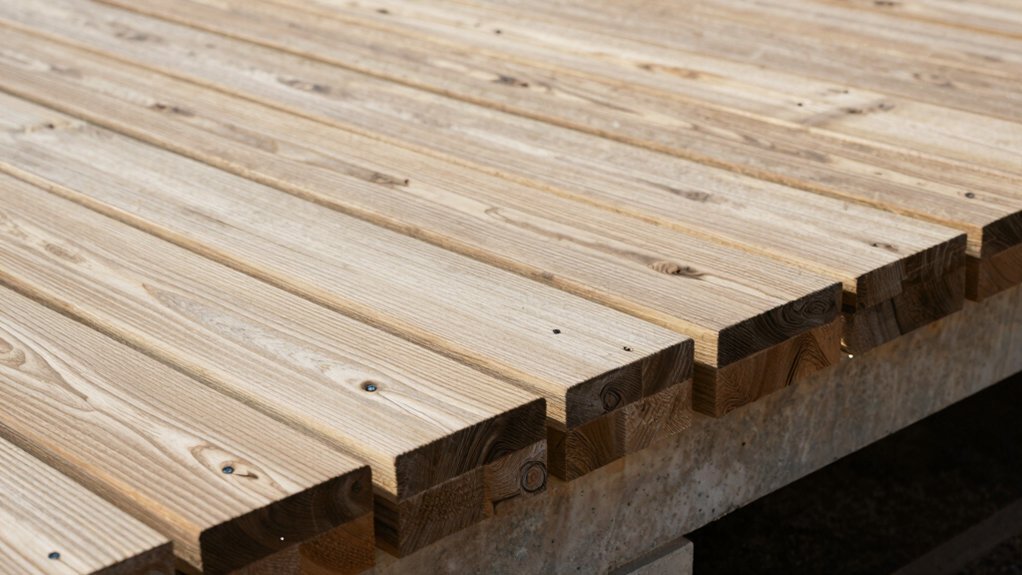
When you read span tables and sizing charts, you’ll identify the basic inputs—deck width, load, and joist spacing—and map them to allowable joist sizes. These charts translate distances and weights into specific joist dimensions, so you can choose lumber that meets code and service expectations.
Start by confirming units, definitions, and any local amendments before applying the numbers to your deck design.
Reading Span Tables
Reading span tables can quickly tell you which joist sizes correspond to specific spans and loads, so you can pick a member that meets structural requirements without overdesign. You use them to match nominal dimensions with allowable spans, considering species, grade, and treatment.
Interpret each row as a paired reference: a listed span for a given joist depth and spacing, under a defined load. Verify factors like deflection limits and supporting conditions, then translate the data into a practical member selection.
Focus on beam strength for the chosen layout and ensure that the member remains within safe bending and shear limits. Material durability also matters; confirm whether treated or naturally durable wood suits outdoor exposure.
Always check local codes and manufacturer tables for alignment with installed conditions.
Sizing Chart Basics
Sizing charts and span tables work together to translate joist dimensions, spacing, and loads into practical member sizes. You read the charts to determine allowable spans for your deck material, then pick joist sizes that fit both span and spacing constraints.
Begin with nominal dimensions, then verify actual member grade, species, and load category. Span tables account for live and dead loads, bearing width, and end support conditions, so you can compare options quickly without recalculating each scenario.
Sizing charts convert those spans into recommended lumber sizes, subflooring thickness, and notches or overhang allowances. Use this data to balance strength, stiffness, and deflection criteria against budget considerations.
Always cross-check with local code limits and manufacturer deltas to ensure a safe, compliant installation.
Plan Load, Span, and Support for Your Deck
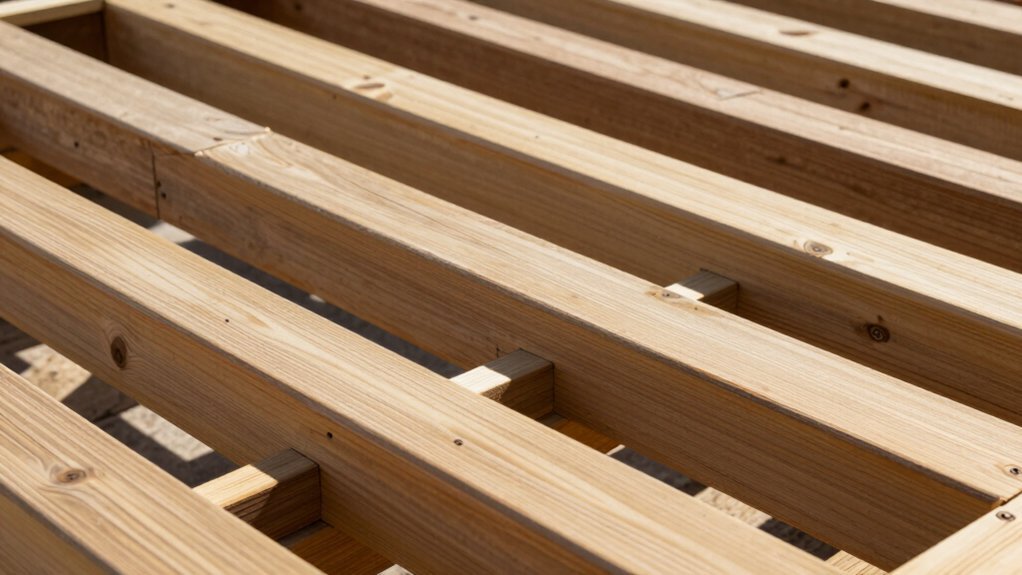
Plan loads, span, and support for your deck depend on the anticipated loads, the deck’s layout, and the chosen framing. You determine live and dead loads, assess tributary areas, and select joist spacing that meets code and safety margins.
Span calculations hinge on deck material, lumber grade, and supported beam arrangement, ensuring deflection stays within limits for long-term performance. Consider weather resistance and environmental exposure when choosing framing components, fasteners, and protective coatings.
Specify edge clearances and guard height to maintain structural integrity under wind and snow loads. Prepare a load path from joists to beams to posts, validating that the footing design accommodates frost heave and soil conditions.
Document assumptions, spans, supporting members, and anticipated service life for accurate construction guidance.
Installing Joists: Cutting, Notching, and Fastening Best Practices
To install joists correctly, you must cut to exact length, notch only where permitted, and secure fastenings with code-compliant hardware. You verify spacing per design, then predrill where required to prevent edge splitting. Use galvanized or stainless connectors, with approved nails or screws, and maintain consistent face nailing where specified.
Joist reinforcement is applied at mid-span or near bearing points only as engineered, not ad hoc, ensuring load transfer remains uniform. Notches respect column or ledger limitations, avoiding over-cutting and preserving structural integrity.
When fastening, stagger fastening pattern to distribute stress and prevent creep. Consider decorative accents only after primary support is established, ensuring hardware and framing remain unobstructed.
Inspect connections for tightness and corrosion resistance, and document adherence to applicable code requirements.
Achieving Slope and Level: Long-Term Maintenance Tips
Maintaining proper slope and level over time demands proactive checks and disciplined adjustments. You’ll implement a scheduled inspection routine to verify deck incline after seasonal shifts or heavy use.
Start with a fresh slope calculation, confirming the established rise over run targets for drainage and surface comfort. Use a calibrated level and measuring tool across multiple joists to detect deviations beyond preset tolerances.
If you observe low spots or sagging, plan corrective shimming or joist re-levelling, prioritizing structural stability and fastener integrity. Document measurements, adjustments, and environmental factors that could influence results, feeding this data into your long term maintenance log.
Regular rechecks after weather events or ground settling ensure sustained performance and reduce future remediation, preserving decking longevity and safety.
Common Joist Mistakes and How to Avoid Them
Common joist mistakes undermine deck stability and longevity, so catching them early saves time and expense. You’ll likely err with improper joist spacing, which can cause flex, sheathing splits, and premature failure. Confirm spacing per design loads and local codes; uniformity matters for load transfer and surface uniformity.
Avoid under-sizing—overspanning leads to sag and bounce. Treat wood to resist moisture and insects; neglecting wood treatment invites rot and warping, especially at ends and faces exposed to weather. Ensure correct fastener patterns and corrosion-resistant hardware; pilots, screw depth, and spacing influence hold-down strength.
Seal end cuts to minimize moisture absorption. Maintain ventilation beneath the deck to reduce standing water. Schedule periodic inspections, checking for loose boards, rust, or shifting joists, and correct promptly.
Frequently Asked Questions
How Do I Determine Joist Spacing for Uneven Terrain?
To determine joist spacing on uneven terrain, you measure grade changes and use a leveling string line, adjusting spacing accordingly; maintain consistent load support. For uneven terrain, use hip-to-hip adjustments, calculating each joist individually to guarantee even load distribution.
Can I Reuse Existing Joists From a Different Deck?
Yes, you can reuse joists from a different deck if they pass a thorough joist inspection and are compatible with your substrate and fasteners. For example, inspect for rot, cracks, and termites, ensuring material compatibility and load capacity.
What Permits Are Required for Replacing Deck Joists?
You need a permit before replacing deck joists, and you must complete a deck inspection as part of the permit process, submitting structural plans and compliance details to your building department for review and approval.
How Do Weather and Humidity Affect Joist Durability?
Weather and humidity reduce joist durability by promoting moisture ingress; guarantee moisture resistance and use proper wood treatment. You’ll see warping or decay if humidity rises; select treated lumber, seal joints, and maintain drainage to sustain performance.
Are Hidden Fasteners Better for Joist Longevity?
Hidden fasteners can improve joist longevity by reducing nail pops and movement, minimizing surface splitting, and distributing load more evenly; you’ll experience steadier decking, fewer squeaks, and better long-term performance when consistently installing hidden fasteners.
Conclusion
Deck joists are the frame that carries your deck’s weight, so understanding sizing, spacing, and materials keeps your structure safe and durable. You’ll interpret span tables, select appropriate lumber, and plan supports with precision. Cut, fasten, and notch correctly; maintain slope and level for long-term performance. Avoid common errors by following code guidelines and manufacturer specs. With careful planning and proper installation, your deck will stand strong—nearly indestructible, like a titanium fortress under the stars.